
Viji Nakka-Cammauf
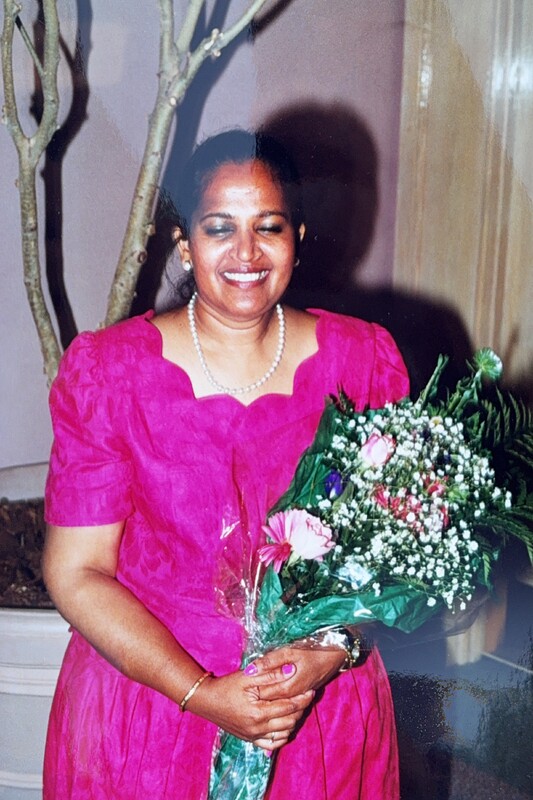
A Word from God to a Young Woman in Madras
From her earliest days, Rev. Dr. Viji Nakka-Cammauf wrestled with the deep questions: Who is God? What is my purpose? How can I escape karma?
Born to a Hindu family in Madras, India, Viji Nakka grew up in a culture layered with spiritual devotion and caste inequality. Her father was an agnostic who loved literature; her mother, Guna, was a deeply spiritual woman—a matriarch whom neighbors sought out for wisdom, a woman who prayed morning and evening, fasted every Friday, and created in her home what Viji would later recognize as sacred space. The rhythms of Guna’s piety—the bathing, the altar, the silence—would accompany her daughter across oceans and decades, finding new expression in a vibrant Christian life that never forgot where it began.
It was a school oratory contest that set Viji’s spiritual crisis in motion. The prize required enrollment in a class studying the writings of Mahatma Gandhi. That class cracked open Viji’s world. Until that moment, she had simply followed whatever her family and culture followed. For the first time, she became aware of the caste system, the treatment of women, the social evils her own tradition had woven into its fabric. “Where is this caste thing coming from? Where is this inequality between men and women coming from?” she asked. The question sent her on a years-long search through the world’s religions, asking her spiritually strong friends: “Tell me about your beliefs.”
Eventually, she asked the same question of her Christian friends. The Christian faith was simpler compared to the Hindu faith. But when her mother found out, Guna warned Viji superstitiously, “If you do this, something hurtful will come to you and to our family.” So Viji carried her questions quietly, waiting for a place where she might ask them without fear or guilt. “I thought, ‘When I get to America—a Christian country—I can finally explore this without pressure.”
Oakland, 1979: “God Prepared This Place for Me”
Viji arrived at Mills College in Oakland in 1979 to study American literature. Viji loved Robert Frost and Emily Dickinson, and her parents had pooled their resources to send her abroad with one semester’s fees in hand. The plan was to earn a degree, return home, and teach. God had a different itinerary.
Mills College—founded as a Christian seminary for women—had become very secular. Viji went to the campus chapel to find a spiritual community. It was completely empty. Viji feared she would not survive without it. “Is this a God-forsaken country? Or at least a God-forsaken school? I’m not going to survive without a spiritual community!”
Fortunately, she came across InterVarsity Christian Fellowship. The campus group was composed of seven students. In Viji’s words, “They were like lights on the campus. They lived exemplary lives. They helped students. They gave sacrificially. They would do amazing things.” She had never seen anything quite like this. She began attending their Bible studies not to believe, but to ask questions. The InterVarsity leaders were willing to answer every one of her questions.
One woman, Geri Rodman, who would later become the president of InterVarsity Canada, refused to let Viji syncretize her Hindu beliefs with the new faith she was exploring. “Jesus requires absolute loyalty,” she told Viji. Viji did not like Geri for a while. But the clarity she needed was not compromise—it was truth. And through Geri, through a young married couple at First Covenant Church of Oakland named Linda and Russ Warne (who had just returned from Urbana and made a commitment to house international students), and through countless moments of impossible provision, three things became clear to her: there is only one God; he died for her sins, and she did not have to earn salvation; and she was created with a purpose. This was very critical for her. When she joined Gandhi’s movement, she wanted to have a purpose in her life. “I was willing to give my life for anything that was really worth it.”
Viji said, “I know this is a huge risk with my family. I would never want to go against them or hurt them. But I felt I had found something I absolutely need, and I’m all alone here. I need to trust Christ.”
She came to faith in Christ at the end of 1979. But she was still in crisis. She put her trust in Jesus, and she still had her Hindu chants. Am I a Christian? Am I a Hindu? There were no Indian Hindu converts around her who knew what this crossing felt like. She navigated it, she says, because the Lord himself met her in ways she could not explain.
The head of the English department, Dr. Elizabeth Pope, observed this foreign student trust God for everything from tuition to housing, and eventually said to her, “Viji, there is a God. And he works for you.”
And there was First Covenant Church, the congregation in Oakland founded in 1887 by Swedish immigrants. Viji found herself drawn to the solid biblical teaching, the warmth of Pastor John Notehelfer and the rootedness of a multi-generational community.
Before she left India, Viji had gone to a small Christian fellowship without her parents’ knowledge. They gave her a scripture from Exodus: “I am sending an angel ahead of you to prepare the place where I will bring you.” Looking back, Viji says that “Mills was one of those places. And First Covenant was the other.”
“No, I am not going to be a pastor”
Viji had not come to America to become a pastor. She had come to study literature. Nevertheless, Viji felt God’s call in a different direction. After resolving to surrender her dreams of studying American literature, she discovered the perfect doctoral program: a PhD in Theology and the Arts at the Graduate Theological Union in Berkeley, California.
But to qualify for the doctorate, Viji had to take theology courses at the American Baptist Seminary of the West. The seminary dean, named Malcolmson, watched her interactions with students and faculty, and told her plainly: “You are a pastor to pastors. You need to go into pastoral ministry.” Viji said, “No, I am not going to do that. I’m not that person.” Malcolmson replied, “You had better accept it.” Viji dismissed this as his personal opinion. She just wanted to do her doctoral program.
The actual call came in an Introduction to Ministry class, one of the required courses for the Master of Divinity degree. The professor, a pastor himself, would teach theory one week and then bring real people into the classroom the next—parents of children who had committed suicide, people in the depths of suffering—and say to the students: “Now minister to them.” On the final day of class, a group of women who had been sexually abused by their fathers, including by a pastor, came to speak. Viji sat by the door, planning to leave right away. “I cannot handle this. This is not anything I’m used to. It’s too painful!”
She was the only Covenant student in a class full of Baptists and felt, by her own description, completely unequipped for the weight of what these women carried. When the professor asked which student the women wanted to pray for them, they chose Viji. She told the professor she could not. He did not allow her to get out of it. So Viji begged God for words. “God, what do I do now? Anything I say will be insensitive. I can’t.” But she prayed through the struggle and prayed whatever came to her mind. When she finished, all the women were in tears and asked if they could come share their stories with her college group.
“That was when I said to God, ‘It’s too scary. I don’t want to be involved in this.’ And God said: ‘This is the call.’ I thought, this spoils everything for me. My plans are all gone. This is what it means to be called.”
First Covenant, 1992: The First Woman of Color Ordained in the ECC
Viji began volunteering at First Covenant Church of Oakland as a natural continuation of her InterVarsity involvement, leading college Bible studies, working with youth pastor Dave Hicks, doing pastoral internship work to fulfill her degree requirements.
When the new senior pastor, Randy Roth, asked Viji to come on staff as a Missions and Prayer Associate, the legal reality of her immigration status intervened. An attorney told her plainly: without ordination, there would be no green card; she could not be employed at FCC. It seemed impossible. Viji did not believe FCC would ordain her. She had never seen a woman preach from the pulpit. Three men in the congregation were known to have voted against women’s ordination at the 1976 Annual Meeting vote.
Viji loved First Covenant too much to ask for an ordination. She considered getting ordained through the Baptist church. A Baptist church had already invited her over.
Over some time, Viji had been quietly laying groundwork at FCC, sharing resources from Christians for Biblical Equality and their journal, the Priscilla Papers, with the college students she shepherded, presenting the biblical case for women in ministry in a non-threatening, invitational way. But she was not certain the congregation was ready.
She drove away from the attorney’s office with what felt like an impossible situation, turned on the radio, and found herself listening to a reading of John 11, the story of Lazarus. She recognized the voice of God in it: “This thing looks dead, but I am going to revive it. You only have to believe.” Viji knew right away that something was going to happen at her beloved church. God was in control.
She arrived at a leadership retreat at Mission Springs, an ECC camp and conference center. She went searching for John Notehelfer, then serving as superintendent of the Pacific Southwest Conference. When she told him what the attorney had said, he replied without hesitation: “Viji, I am ready to license and ordain you as soon as you want.” She could not finish her lunch. John called Pastor Randy Roth, the Lead Pastor of FCC. Both men agreed that Viji should be ordained.
The vote before the church board was unanimous. One of the three men who had voted against women’s ordination—the church chair and the superintendent of San Leandro schools—told her privately that he had changed his mind and completely supported her ordination because of how she had pastored his daughter. The other two men were unable to be present for the vote. “I was doing nothing,” Viji says. “God gave me favor. God was creating the way.”
At the 107th Annual Meeting in Florida in 1992, Viji Nakka-Cammauf was ordained in the Evangelical Covenant Church, becoming the first woman of color to be ordained in the denomination’s history. She was completely unaware of this milestone at the time.
Miraculously, she returned home to Oakland and found her green card on her desk, waiting. In retrospect, it was as though God wanted her to take that step of faith toward ordination before finding assurance of her citizenship status.
In another stunning display of God’s sovereign control, when Viji came back to First Covenant Church, she was asked to preach on John 11, the same Scripture verse that God put in her heart four months earlier. From the attorney’s office to the pulpit, four months—the same number of days Lazarus lay in the tomb. “God was showing me that he was in perfect control. Not to do anything to sabotage it. Just be quiet an listen, and let him do the work.”
A Ministry of Women
What becomes unmistakable when one traces the arc of Viji’s life is the continuous thread of women who carried the light forward, passing it from one to the next across cultures and generations. Her mother Guna, who never knew Christ but who taught her daughter to pray, to fast, to be silent before the divine, to center her days around the sacred. The Irish Catholic nuns at her school in India. Geri Rodman, who told her the truth about Jesus when she wanted something more comfortable. Linda Warne, who discipled her as a new convert in a tiny apartment in Oakland. Deirdre Banks, the Director of Christian Education at First Covenant and head of the Covenant Women's Ministries, who called out her gifts and told her she should succeed her. A chain of women, each one pulling the next forward and up, each one laying a healing hand on Viji.
This is not incidental. Viji herself notes that in Hinduism, as in the Oakland of her early Christian years, the deep spiritual life of a community was carried most often by its women. Her mother’s community came to Guna for counsel. The Irish nuns she watched as a girl ordered their lives around devotion. The seven InterVarsity students whose faith converted her were mostly women. Women affirmed her call.
Thirteen Years at First Covenant: Building What She Had Been Given
Viji served as Associate Pastor for Missions and Prayer at First Covenant Church of Oakland from 1989 to 2002—thirteen years of building, mentoring, and making space for others. She developed a rigorous internship program for women exploring ministry callings, requiring them to study, preach, teach, and report. She gave them opportunities in Sunday evening services when the Sunday morning pulpit remained less accessible. She mentored women who would go on to become pastors and missionaries across the country and around the world, including Andrea Dietzman, Kim Notehelfer, and Anita Chick, who would spend years working among the Uyghur people in China. Viji became, as her seminary dean had predicted, a pastor to pastors—not through force of will but through the quiet authority of someone who had been broken open and taught to depend entirely on the God she served.
Little Flock Children’s Homes: The Widows and Orphans
In 2004, Viji founded Little Flock Children’s Homes Inc., a 501(c)(3) charity registered in the United States and, as the Little Flock Charity Trust, with the federal government of India. She continues to serve as its president in 2026. Little Flock is a home in India where orphaned children can receive shelter, food, medical treatment, and educational opportunities. It is a place where they are nurtured, loved, and cherished.
The healing that began in Viji’s own childhood—her questioning of the caste system, her hunger for dignity and purpose, her mother’s prayer—has traveled all the way to the children at Little Flock, who now grow up in a place that says: you are known; you are cared for; there is a God who sent someone ahead to prepare this place for you.
Scholar and Professor
Viji’s PhD in Theology and Literature at the Graduate Theological Union was itself a resurrection story. She had surrendered her plan to pursue a doctorate in American literature when God called her to theology. Then she opened the GTU catalog and found a doctorate in Theology and the Arts, a program that required dual admission to both GTU and UC Berkeley. “God said, ‘You gave it up. But here it is; I’m giving it back to you.’” She almost did not finish the program. Once ordained and serving in ministry, she felt the degree was unnecessary. A weekend at a monastery, a letter from both her parents urging her to complete, and the clear voice of God persuaded her otherwise.
In 2003, Viji earned her PhD in Theology and the Arts from the Graduate Theological Union. Her dissertation was titled “Evil and Repentance in George Eliot’s Novels.” Even twenty years later, she continues to minister through literature in her counseling and mentoring.
The reason became evident when Paul Larsen, former president of the Covenant, called her after she finished and invited her to join the board of the William Carey Heritage Foundation, which would eventually create a PhD program in India at Sam Higginbotham’s Institute of Science, Agriculture, and Technology (SHISAT). Without the degree, she could not have taught.
Viji continues to teach Spiritual Formation to doctoral students at SHISAT. Many Indian pastors arrive convinced they do not need the class. But by the end of the first lecture, their minds are changed. She guides them through exercises of self-examination, silence, and solitude, a new practice for many.
In one instance, a pastor who had planted twenty churches discovered, for the first time, that he had never been loved for himself, only used. He finally felt God’s unconditional love. Viji is always surprised by what God does in those classes. She would never have imagined that she would be back in India teaching pastors.
She is also the editor of The Asian American Christianity Reader for the Institute for the Study of Asian American Christianity, which she co-founded. She additionally serves as a lecturer at the American Baptist Seminary of the West and as an adjunct for the Westmont College Mayterm Program in Missions and Social Justice. She serves on the boards of the William Carey Heritage Foundation and Covenant World Relief and Development. For the Pacific Southwest Conference, she chaired the Committee on Ministerial Standing and the Russia Committee.
Gratitude for the Evangelical Covenant Church
When asked what wisdom she would offer the Evangelical Covenant Church as it marks fifty years of women’s ordination, Viji does not begin with a policy argument or a theological treatise. She begins with gratitude. “First, I would thank the Covenant Church for its advocacy for women in ministry. They have done it in spite of so many other churches not being able to do it. They way the Covenant does it is so collegial, so supportive.” She speaks of the denomination’s nurturing role: “All the Covenant has to do is create space, create opportunities, empower and support women, and they will be the richer for it. The church will be the richer for it. And the kingdom is going to benefit from it.”
After her ordination, she says, she understood something she had not sought: a platform. And with it came responsibility. Many Covenant churches used her like “a little Guinea pig.” Churches that were uncomfortable with the thought of a woman pastor would invite Viji to preach. Once she had preached, the door cracked open, allowing other women to enter. Women like Nancy Lewis and Andrea Dietzman. When asked if she felt like she truly became a pastor to pastors, as the seminary dean had named years before, Viji said it was more like being a friend to pastors. Viji never made a big deal out of her ordination. She gives the credit elsewhere. “I was doing nothing. God was doing the work.”
To young women today who feel called but uncertain, she offers the parable of the talents and the urgency of a short life: “You’re here for a short time on this earth. What can you do for God in heaven? You can only do it here. If he’s called you, you’re going to have to say yes. There’s just no other way, or you will lose that joy.”
The Angel God Sent Ahead
In a small fellowship in India, before she ever boarded a plane to Oakland, a group of Christians prayed over a young woman who was leaving and gave her a promise from Exodus: “I am sending an angel ahead of you to prepare the place where I will bring you.” She did not understand it then. She was going to study Emily Dickinson. She was going back home to teach literature.
But the angel went before her to Mills College, where seven students in an InterVarsity chapter were living the kind of lives she had never seen. The angel went before her to First Covenant Church, where a couple named Linda and Russ Warne had just come home from Urbana and made a commitment to take in international students. The angel went before her to the American Baptist Seminary of the West, where an atheist dean would recognize in her something she could not see in herself. The angel went before her to a GTU catalog with a PhD in Theology and the Arts. The angel went before her to a leadership retreat at Mission Springs where Superintendent John Notehelfer happened to be sitting in a dining hall. The angel went before her to Florida, back to a desk in Oakland, and to a rural village in India, where children now wake in the morning under a roof prepared before they arrived.
This is the story of Rev. Dr. Viji Nakka-Cammauf. It is a story about the Evangelical Covenant Church’s willingness, fifty years ago, to make space for what God was already doing. It is the story of a young woman’s willingness to follow God’s voice even when it seemed impossible.