
Nancy Gordon
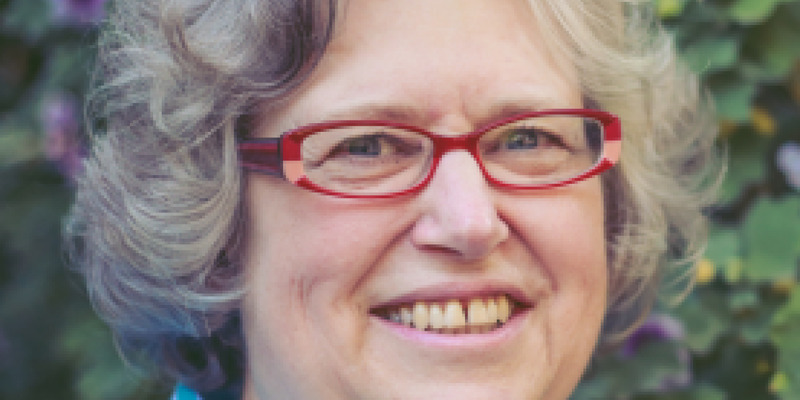
- Name
- Nancy (DeHamer) Gordon
- Year of Ordination
- 1994
- Item sets
- Women's Ordination - People
- Media
 Nancy Gordon Image.png
Nancy Gordon was born in Covina, California. Her father was attending Azusa Pacific Bible College (later Azusa Pacific University) preparing for ministry, following service in the U.S. Army during World War II. By the time he graduated in June 1950, twins (Jim and Patty) had joined the family. After graduation the whole family moved to Fort Sumner, New Mexico, where her father became pastor of the Church of the Nazarene.
Pastorates in two small California towns followed, until 1960 when the family moved to Medford, Oregon, and her dad became pastor of the Mount Pitt Avenue Church of the Nazarene. Medford was bigger than the small agricultural towns they had lived in and in some ways was a culture shock. Nancy went from seventh grade in a self-contained grade-school classroom to eighth grade in a three-year junior high, where classes changed every hour, with 1200 students.
Although the transition was in many ways difficult, Nancy soon found the following advantages: a bigger library (she had pretty much read all the books the librarian considered appropriate in her small town library), opportunities to sing in musical groups at school and at home, and a school system that prided itself on providing a challenging, excellent education. Nancy thrived in this environment and made it her goal to graduate in the top 5 percent of her class.
The Gordon family spent the weekend of John Kennedy’s assassination (1963) cleaning out the parsonage on Mount Pitt Avenue and moving to a nearby rental home. Her dad was taking a leave from pastoral ministry that lasted until just before the end of her senior year in high school. With both her mom and dad working, Nancy assumed larger responsibility for her younger siblings—Jim, Judy, and Becky. (Patty was killed in a house fire when she was eighteen months old.)
They attended a larger Church of the Nazarene where Nancy became president of the youth group and sang in the church choir. Just before she graduated in the top 5 percent of her class, she planned and led a youth group retreat.
While she had accepted Christ at a young age, and church and faith were always a part of her life, it never occurred to her that she should think about ministry. All the ministers she had seen (except for some eccentric women evangelists) were men. And having seen some of the downsides of ministry growing up in the home of a pastor, it did not seem like something she wanted to do. The options that seemed open to her were teaching or nursing. Since high school math and science had not been her favorite subjects, she decided that she would pursue teaching. By that time she had substituted in enough Sunday school classes to think that she might enjoy it.
So in the fall of 1965 she headed off to Northwest Nazarene College (now Northwest Nazarene University) in Nampa, Idaho. Her college years were a time of intellectual and spiritual growth. She majored in history, with a minor in German, and the requisite secondary education courses to get a teaching degree. She sang in a Christian worker’s band quintet that went out on weekends to sing and play for churches. While she enjoyed her history courses, the courses on Bible and theology were very interesting to her—with her favorite course being one on the Epistle to the Romans. Even though somewhat removed from the tumult of the late 1960s, the ferment about war and the roles of women in society made themselves felt even there.
When graduation came in June of 1969. Nancy was engaged, getting ready for her wedding and her first job at the Idaho State Historical Society. She had done a work-study there for over a year during college and upon graduation was hired to be the Assistant Curator of Collections. There Nancy processed hundreds of historical objects and photographs, reworked the classification system they were using, substituted as a presenter in the educational programs, and wrote a bi-weekly column on local history for a weekly ad paper.
She and her husband. Dale DeHamer, moved to Oak Ridge. Tennessee, in 1971 when he started a PhD program in Biochemical Genetics. Shortly after their arrival their first child, Melinda, was born. While in Tennessee Nancy received a Master’s in Library and Information Science. The question for one research project was “Should the library convert to a computerized card catalog?” She worked as interim for both the Tennessee Valley Authority and a regional library, where her position was funded by federal grants to extend library service to underserved Appalachian communities in Tennessee. In that job she was exposed to a whole new culture and way of life.
In 1975 Nancy’s husband completed his PhD and the family moved to Iowa City, Iowa, where he was in medical school for four years and Family Practice Residency for three. Nancy became the primary salary earner by working at the Herbert Hoover Presidential Library as an archivist. One of the highlights of her work was working on the papers of Rose Wilder Lane, the daughter of Laura Ingalls Wilder. Some of the original manuscripts of The Little House books were a part of those papers. Also, during that time their second daughter, Mary Beth, was born.
When her husband finished residency, he began working as an emergency room doctor in small Iowa hospitals. Nancy took a breather from paid work and found, for the first time in many years, the time to think about what she wanted to do with the rest of her life, absent family financial needs.
The family always had been involved in a variety of churches. But Nancy realized in her first year of time away from paid work that she really enjoyed doing church stuff—teaching adult Sunday school, editing church newsletters, helping plan church retreats. A female associate pastor at the Mennonite church they were attending invited her to a conference on women in ministry. When she asked the person why she had invited her, the pastor said, “You obviously have the gifts and talents for ministry. What you’re going to need to decide at some point is this: is volunteering enough?”
Although she did not attend that particular conference, Nancy did tuck those words away, along with realizing that she was really being drawn and pulled toward some sort of work in the church. In 1983 the family moved to Salem, Oregon, where her husband joined a multi-specialty practice. In Salem they lived just blocks from Trinity Covenant Church; in fact, they could see the steeple from their kitchen window! It was one of the first churches they visited. From the first day there, she knew she had found the church she wanted to attend.
Nancy had six years of what she calls her “sabbatical” in Salem. There she had the gift of time—time to pursue a more intentional relationship with God through the reading of scripture, prayer, and journaling. She was able to edit some small topical magazines for the Trinity community, co-lead women’s Bible studies and small groups, sing in the choir, and serve on the diaconate. Her pastor, David Smith, encouraged her efforts and began to suggest that he thought God was calling her to something, and that he would like to be a part of discerning what that call could be. It was at that point—as her sense of call was becoming clearer and she was actually able to say out loud she was being called to ministry—that her seventeen-year marriage failed.
Ending the marriage was not her choice. But Nancy learned the difficult lesson that she was in a situation that she could not fix on her own and that her hard work was not enough. While grieving the loss of her marriage, she wrote a book with her sister on pregnancy loss. It was published as Good Mourning in 1989 and republished as Silent Cradle in 1998.
During the divorce experience Nancy also experienced the grace of God. primarily through the supportive actions of the members of Trinity Covenant Church. They helped her pray through various options for rejoining the working world. And gradually the decision was made to apply to seminary. She applied to several but chose Garrett Evangelical Theological Seminary in Evanston, Illinois. It offered her substantial financial aid, including the Virgil Bjork Scholarship and there were good public schools in Evanston for her nine-year-old daughter. “Leaving Salem in the U-Haul truck was the scariest thing I ever did.”
Her three years at Garrett were intense: she remembers feeling every week by Wednesday that she had no more room left in her brain for any new material. During that first fall a fellow seminarian pointed her to Winnetka Covenant Church, where she became a regular attendee and then a member. When it was time to do field education, the Winnetka church created a position for her. One of her primary ministries was beginning a single women’s group that became an important place for many others in the church and the community. In her second year the group sponsored a weekend retreat for all the women of the church, which has continued each year until the present.
Even though she had had doubts about the openness of the Covenant church to women like herself, her experience at Winnetka encouraged her to pursue ministry in the Covenant Church. She cross-registered for many courses at North Park Theological Seminary and was able to take all the required courses for Covenant ordination. She felt like she had received the best of what both seminaries had to offer—Garrett even had a professor whose specialty was pietism!
Like other women, when Nancy graduated from seminary in 1992, the offers from churches did not exactly pour in. But several people at Winnetka expressed an interest in having her continue her ministry with them. She stayed, working as a pastor with the women’s group, welcoming newcomers through the evangelism committee, and in creating more ways and places to do adult formation and education. She and other ministry staff members created a Wednesday evening supper and activity night for all members of the congregation. Nancy co-led an adult class on Wednesday evenings that provided time for more in-depth study of the Bible. At the 1994 Covenant Annual Meeting she was privileged to celebrate her ordination with members of Winnetka Covenant Church as well as members of her family who came from the West Coast for the event.
While at Winnetka she also found ways to serve the larger church. She was asked to write a study guide for the two-volume work, Servant Leadership, that included articles by many Covenant denominational officials and seminary professors. After the Covenant Annual Meeting of 1994, she wrote President Paul Larsen a letter, volunteering to serve on the Task Force on Sexual Harassment and Abuse that had been called for by the Central Conference and its superintendent Herbert Freedholm at the Annual Meeting. She was a little surprised when, several months later, Larsen called to ask her to chair that task force. Composed of denominational officials, lay persons, a representative from the seminary, and several pastors, it began meeting after the 1995 Covenant Midwinter Conference. The purpose of the group was to articulate a way for congregations to respond to allegations of sexual misconduct, educate the church at large on the issue, and promote ways of preventing such misconduct in church and ministerial settings. For many reasons, it was a large and difficult task. For over a year the group worked together. They arrived at consensus on a document that was presented to the Annual Meeting of 1996 and recorded in its minutes. While not all the recommendations of the task force were implemented, the creation of a standing commission resulted. The Commission on Response to Sexual Misconduct would continue to monitor how the church was doing with this issue and to provide a process of education for prevention. Nancy served a five-year term on that commission when it was formed.
Another area of opportunity was to advance women in ordained ministry (then only Ordination to Word and Sacrament) in the Evangelical Covenant Church. For many years the Task Force on Women in Ministry, formed by the denominational ministerium, provided leadership for a meeting of women in pastoral ministry at the annual Midwinter Conference. Frances Anderson of North Park Theological Seminary faculty asked Nancy to reorganize this gathering, which she did in 1996 and 1997.
In doing so, she realized the need for the group of clergy women to organize itself for opportunities of advocacy, fellowship, resources, and education. It was significant that the numbers of women clergy interested were finally large enough to formally organize. A group, primarily from the Chicago area, drafted a constitution. It was presented at the February 1998 meeting and provisionally approved. A slate of officers was elected and charged with coming back to the 1999 meeting with a final constitution and nominations for permanent officers. Thus, the Association for Covenant Clergy Women (ACCW) was born. Nancy served as its first president from 1998 to 2002.
During the early days of the ACCW, Glenn Palmberg was elected president of the Covenant Church. Together with the ACCW, he encouraged a Consultation on Women in Ministry that would include leaders of many venues of the denomination. Nancy and Timothy L. Johnson, then president of the Covenant Ministerium, met to plan such an event. Held in September of 2000, it included times of worship, theological reflection, and strategizing in various components of the broader church. One of the highlights was a study by president and dean of the seminary Dr. John Phelan, who emphasized Jesus’ ministry of crossing boundaries to include all believers in the kingdom of God. Nancy says, “Leaving that event, I felt like we had a new. more positive way of talking about the issue, and that as a church we were more committed than ever before to find ways for women to serve and use their gifts in pastoral ministry.”
One significant outgrowth from that roundtable was the establishment of the Commission on Biblical Gender Equality. Again Nancy was an inaugural member, serving until 2006. At last the educational resources denied in the 1976 Annual Meeting votes (approving the ordination of women and yet denying expense for educational strategies) could be developed! The Commission published All God’s People by John Phelan and Called and Gifted by Sharon Cairns Mann. The latter gave momentum for a Called and Gifted DVD that was shown at the 2006 Annual Meeting, which marked the thirtieth anniversary of the vote to ordain women.
Meanwhile, Nancy experienced the reality of being a woman in ministry seeking a call to serve a Covenant church. After five years as associate pastor at Winnetka, she sensed the need for a new place of ministry, hopefully as a lead or solo pastor. When no opportunities became available, she received an invitation to consider a ministry at a non-denominational retirement community, Friendship Village in Schaumburg. Illinois. The position, director of growth opportunities, called for a clergy member to pull together many programs under the “spiritual” umbrella, including chapel ministries. She began ministry there at the start of 1998.
That year marked a new beginning for everyone in the family. In June, Mary Beth, who had been nine when Nancy started seminary, graduated from Evanston High School. Her older sister, Melinda, graduated from University of Chicago Medical School. And Nancy moved to Schaumburg to be closer to work. Once there she developed a ministry team that provided a variety of program endeavors. Currently she is part of leadership developing a new building, due for completion in June 2007. It will house many of the programs that her team has developed and will be a bridge to the wider community.
As Nancy reflects back on her journey, she is grateful for her parents, who both demonstrated a gifted way of doing ministry and who encouraged her to serve God in any way she could. She is grateful for pastors who sensed her call almost before she did and encouraged her to consider going into ordained ministry. She is grateful for the many women with whom she has worked and walked in the journey of contributing to making Christ’s church the best it can be so that all who come to it are safe and able to be valued in using their gifts in the ministries to which they have been called.
Nancy Gordon’s clear vision and persevering spirit has both strengthened clergy women and strengthened the Covenant’s commitment to accept God’s calling and gifting of women for pastoral ministry.