
Frances M. Anderson
- Name
- Frances M. Anderson
- Year of Ordination
- 1985
- Item sets
- Women's Ordination - People
- Media
 npu_hpc_23549_large.jpg
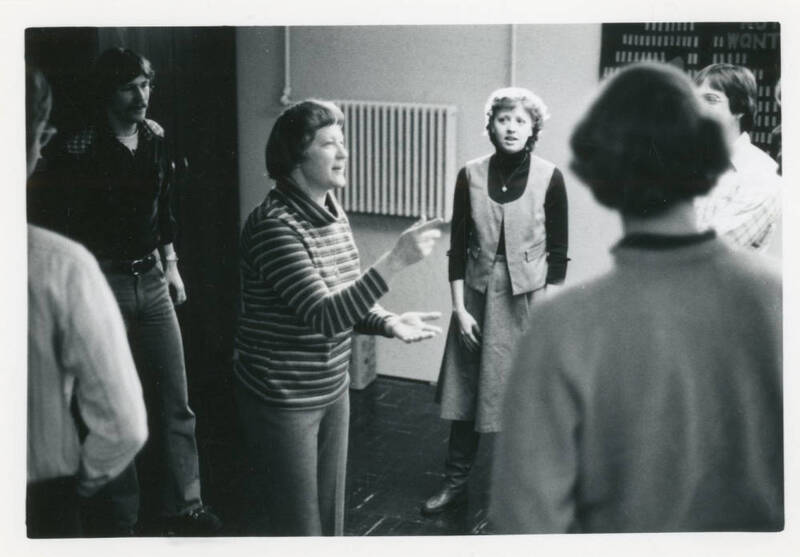
Born in Cody, Wyoming, on September 1. 1931. to Roy and Mamie Anderson, Frances M. Anderson is the second of five children. A brother, Delmar, is the oldest. Fred, Lois, and Jon follow Fran. Before Fran began school, the family moved from Wyoming to the small town of Mead (pop. 260) in rural Nebraska.
The Mead Covenant Church, together with the influence of her Christian parents, nurtured her in the faith, and she made her commitment to Christ at age eleven during vacation Bible school. Visiting missionaries were regular guests in the Anderson home. Hearing interesting stories of far away places and the Christian witness they were privileged to bring in those lands deeply impacted this young girl. Harvey and Ruth Widman, missionaries in the Congo, were particularly influential in setting Anderson's sights on nursing school and Africa.
In the 1940s girls were tracked to grow up into marriage and motherhood. First they might have served in the armed services, or trained as stewardesses, secretaries, teachers, or nurses while waiting for marriage. As mysterious as the call of God often is, Anderson sensed even as young as eleven and twelve that she wanted to give her life in service to God. In that era, a woman called to ministry had one option: missions. Anderson jokes that if she had been Catholic, she most certainly would have become a nun.
In the Anderson family academic honors were assumed but not praised or recognized. Achievement was bred into her and she did well in school. Knowing where she was going —Africa, specifically the Congo —Anderson began her trek by enrolling in one year of pre-nursing and then entering the School of Nursing at Swedish Covenant Hospital in Chicago, becoming a registered nurse. She followed this study with two years at North Park Theological Seminary (NPTS) in the missions course and one year at the University of Nebraska, earning a bachelor of science in nursing in 1956.
For a woman, missionary/nurse/teacher was the approved package of the time. Anderson had one other love to develop: education. Nursing was the way into missions but teaching was the other leg of this three-legged stool. As a nurse, Anderson made it a point to incorporate an educational component into her preparations. She enrolled at NPTS. earning a bachelor's degree in religious education. The seminary, not the college, conferred this particular degree. In her first Biblical studies course at the seminary, Anderson was the only woman in the classroom. After the mid-term exam, the professor announced to the class that the woman student had earned the top grade. The silence of the men students was profound. Anderson took the remainder of her required Bible classes at McCormick Theological Seminary in Chicago.
During her final year at seminary an unanticipated opportunity presented itself, altering her future and reshaping her dreams. Anderson writes:
While working as night supervisor at Swedish Covenant Hospital and finishing my studies, I was asked to work part-time in the denominational Department of Christian Education to finish writing a curriculum project (begun by Sylvia Peterson), which I did. The following year I was asked to allow my name to be placed in the election for the position of director of children's ministries [for the Covenant]. It would mean a change of direction for my life and I prayed about it and asked counsel from trusted friends. Standing at this crossroad, I could not determine God's leading. I believe the church as Christ's body should affirm one's calling, so I decided to let the church at its annual meeting (1958) affirm the place of ministry for me. My opponent in the election was well known, more experienced, and was a speaker at the annual meeting. I was fresh out of nursing and seminary. When the results of that election were announced, I heard my name declared elected. The direction of my life changed and I committed my life and future into the hands of my Lord and Savior who had been leading me step by step in the path he had for me.
For ten years (1957-1967) Anderson served the Covenant department of Christian Education as director of children's work. Aaron Markuson, executive secretary of the department, was always supportive, giving her the freedom to be creative. Among her substantial accomplishments for the department were: curriculum development for trailblazers (ages 9-11) and pathfinders (ages 6-8); the writing of three books: Children at Worship in the Church, The Young Child in Christian Education, and Team Teaching in Christian Education; curriculum design for vacation Bible school and Sunday school for ages 9-11; and creation of "lab schools" which trained church teachers and leaders on site. Each fall Anderson often traveled for a month at a time for training seminars in various churches around the country.
During these years as director of children's work, Anderson found comfort in the words of Isaiah, "Fear not, I am with you, be not dismayed for I am your God. I will strengthen you, I will help you, I will uphold you with my victorious right hand." (41:10) The work was intense and she enjoyed the challenge. She was the only elected woman in the department, but she was affirmed in her work. She learned to speak the language of the church, visiting dozens of Covenant churches and growing into her position as a professional, as she was also earning a masters degree in Christian Education at McCormick Theological Seminary.
Content in her work in the department and not seeking a change, she was startled one day by a phone call from First Covenant Church in St. Paul, Minnesota. Actually, she received four calls. On their fourth attempt to recruit Anderson to their staff, she agreed and was hired as their director of Christian education.
The pastor was explicit that she was not a pastor. She was told that "women are not effective in the pulpit!" She was not to preach; she was to educate —everyone from newborn to senior citizen. Anderson had oversight for Sunday school, weekday nursery school, children's church, Trailblazers, junior and senior high, college age, girls' discipleship group, family clusters, day camps, Bible camps, work camps. Covenant High in Christ (CHIC), trips, retreats, a drop-in center and a relatively new concept in Covenant youth ministry—mission trips. While in this position, Anderson had her one and only trip to Congo, then called Zaire. It lasted six short weeks. Finally, the vision for missions of a teenage girl in Nebraska thirty-five years earlier came to fruition. Her experience of Africa was as consultant to Covenant missionaries there.
While at First Covenant. Anderson was commissioned, along with Frances Decker, Alva Johanson, and Ted Kincaid, as a Covenant director of Christian education at the 1970 Covenant Annual Meeting. Women and men could both receive this credential from the denomination for such ministries as those to children, youth, and visitation. Several other women in the denomination were working as "parish workers" at the time. While men were licensed for youth ministry without degrees, a few years must pass before the Covenant Board of Ministry would offer licensure to women, which Anderson received in 1974.
During her ministry at First Covenant. Anderson had significant influence on the young people. She believed that youth were not only the church of the future but of the now. She was someone who lived her life as a Christian, taking the students with her into this life. She believed in all of her students and they knew it.
One student who benefited from this mentoring was Marti Brand, who knew she would one day work with youth. Today Marti and her husband, Steve Burger, serve the Evangelical Covenant Church as directors of children, youth, and family ministries. Marti admits, "Everything Steve and I do is based on Fran. She made such a difference in a non-radical way. She understood church politics, but never let it hinder her work. She was a woman before her time."
Toward the end of Anderson's years at First Covenant, a series of unanticipated events occurred. During Lent both pastors were unavailable for a scheduled communion service. Anderson was the only staff member in town. Through the years the church had grown to respect and trust her for the quality of her work and depth of her faith. When she was needed to preach and serve communion. Anderson was ready and willing.
The years in St. Paul were happy and fruitful, but from this place Anderson was sought out to become the first woman faculty member at North Park Theological Seminary. Three times the seminary had initiated contact with her to accept this appointment. However, Anderson loved the work she had at First Covenant and had not been looking for a change. Finally. Glenn Anderson, dean of the seminary, made the fourth call saying. "We really want you." She resigned her position in St. Paul and headed for an uncertain future at North Park, one that she had not sought but one clearly directed by God.
Once again Anderson found herself in the position as the only woman on the faculty. This was never a consciously chosen state but now for the third time, a familiar one. On more than one occasion she left faculty meetings for the privacy of her office and wept, as unthinking remarks were made that cut deeply. Her ability to persevere in adversity, instilled as a child, was no less necessary at this season of her life.
Anderson was given the charge to create a master's degree program in Christian education (CE). which would focus on life-long learning for the individual and the congregation. Until that time, the seminary did not offer a CE degree. Students interested in that major came to NPTS for one year of studies, then transferred to the Presbyterian School of Christian Education in Richmond, Virginia, or enrolled in a joint degree program at Chicago's McCormick Theological Seminary to earn their degree. Wanting to offer its own degree program, the seminary appointed Anderson as assistant professor of Christian education to make it happen.
Decades of hands-on experience were now being called forth in the classroom setting. Anderson had been teaching Sunday school since the ninth grade—every age and every setting. Camps, Covenant Youth Caravans, Covenant Bible College, nursery school, Congo, Alaska, confirmation classes, Midwinter Conferences, released time clubs, curriculum development, CHIC, youth mission trips just begin the list. Nurses' Christian Fellowship and Navigators had challenged her spiritual growth during her years in nursing. Ministry at Covenant Mountain Mission in Virginia had honed her relational skills and encouraged her toward leadership. Working for the Covenant department of CE had held invaluable experiences, not the least of which was her travel throughout the U.S. and Canada to dozens of churches to conduct leadership training events. She came to know the denomination, its people and many of its churches. And finally, for eight and a half years she had put it all into practice at First Covenant, St. Paul.
From this field of experience Anderson was asked: "And why do you think you can do what no one else has been able to do so far?" Since she had not sought the job at the seminary, this question by a doubting member of the Board of Ministry was clearly misplaced. Apparently the dean believed Anderson could do what no one else had been able to do. And as she had many times before, she trusted her God who had already accomplished through her abundantly far more than she could have imagined.
The design of the master of arts degree in Christian education (MACE) included four concentration options: children's ministry, family ministry, camp ministry and adult ministry. Two concentrations within the master of divinity degree also were created specifically for youth ministry and CE. In addition to developing two degree programs, she received funds from Covenant Women Ministries (CWM) to launch a training program for seminary spouses. She and Deirdre Banks, then executive director of CWM, set up a three-year curriculum allowing seminary faculty to teach classes and offer retreats on topics such as public speaking, preparing a Bible study, counseling, and parenting.
With a full teaching load (and too many semesters of overload), along with faculty responsibilities, receiving tenure, serving on the denominational board of Christian education, consulting, developing confirmation curriculum, assisting the growing movement of women in ministry, Anderson also returned to school for a PhD. She graduated in 1984 from Northwestern University and Garrett Theological Seminary, Evanston, Illinois. Her area of study was Christian education with a concentration in youth and family.
Klyne Snodgrass, currently the Paul W. Brandel professor of New Testament studies, a colleague, and friend at NPTS, thinks of Anderson as "the first model for women in ministry that women had [in the Covenant]. She was the first to do ministry and first in respect. She loved the local church; it gave her the most obvious joy." Anderson was at the seminary at their request but Snodgrass believes her true joy was out in the church. Together they team- taught the class "Women in Ministry" and at Anderson's urging Snodgrass wrote his first paper in support of women in ministry. Together they celebrated her ordination at the Annual Meeting in 1985.
Debbie Blue was not yet a student at NPTS when she first heard Anderson speak at an "Exploring Your Call" retreat. Impressed that a woman was the speaker and feeling affirmed by the words spoken in support of Christian education. Debbie enrolled at the school. Anderson became her academic adviser and literally saw her through to graduation.
At that time there were few people of color at the seminary or in the class. Preparing her personal story for presentation was an awakening in Debbie's own life. It was a chance for her to take off her mask in front of a mostly white audience, and as she read her paper, she could not look up at her classmates.
Debbie had been honest in recounting her experiences of racism; the room became uncomfortably quiet. Anderson's gentle reply was to pray, and in that prayer to ask God for forgiveness. Such a genuinely sensitive response felt like validation to Debbie as a person of color. Of her professor, Debbie says, "I witnessed a woman of integrity, faith, and courage, reaching out to help a woman like me —validating who we were."
Debbie later served in the Covenant's Department of Christian Formation as the director of adult ministries, and in 2007 was elected executive minister of the new Department of Compassion, Mercy, and Justice. And Anderson still sends her notes of encouragement!
In recognition of twenty years of service to the seminary (1975-1995) Anderson was honored with a Doctor of Divinity, honoris causa in 2002. Again her friend Klyne Snodgrass was beside her, presenting her for the honor. In his own words Snodgrass writes: "This honor is well deserved, for Fran has been a pioneer, one who has worked hard and accomplished much. Her life has been a life of ministry to Jesus Christ and for his church."
Further on he continues:
Like any good teacher Fran has first been a life-long learner. Her record lists studies in no less than five different colleges and universities and four different seminaries, to say nothing about seminars and short courses along the way. Fran's record is impressive, but a listing of degrees and involvement hardly does justice to what this woman has accomplished. When she came to North Park in the fall of 1975, the seminary did not have its own M. A. in Christian Education. Students went one year to North Park and then transferred to another institution to complete their training. Fran, virtually on her own back and in the midst of her own PhD studies, created and carried North Park's masters degrees in Christian Education and Youth Ministry. No one worked harder than Fran, had more energy, or cared more deeply for students. Further, when Fran first felt called to Christian ministry, few avenues were open to women for ministry. She truly was a pioneer in blazing a trail for women in ministry, modeling ministry for them, supporting women students and pastors both individually and structurally within the school and the denomination, and forcing the issues in very constructive ways. Fran may have forgotten, but in her first year she was a catalyst for my own involvement in advocating the place of women in positions of ministry. She was commissioned in 1976 by the Evangelical Covenant Church and then ordained in 1985. Further, she was instrumental in the early days when North Park was just beginning its focus on spiritual formation. She forced us to create new channels for shaping ministers of the gospel. She would not settle for less than what ought to be for Christ's church and the seminary and herself. She has always been committed to Christ and his church, and community always had a high priority for her. Those of us who enjoyed community with her will not forget her investment in this school and this denomination. I am proud to present Fran for this honorary doctorate. Well done, good friend!
Anderson continues to live out her belief that the "call of God does not stop." For three months each year—1996, 1997, and 1998 —she went to Quito, Ecuador, as professor of Christian education at the Ecuadorian Covenant seminary there. She shares a home with Deirdre Banks and jointly they continue to minister. It was to Fran that Deirdre was referred over twenty years ago for advice when seeking licensure. Deirdre recalls, "I grew up in a church where I didn't know women could do such things." And Fran offered encouragement when Deirdre sought ordination in 1993.
Fran and Deirdre co-pastored the Mission Covenant Church in Orange, Massachusetts, for three and a half years. The pastor called to succeed them, Adria W. Pearson, was born the year women were first ordained—1976. and was herself ordained in 2006, the 30th anniversary year of women's ordination in the ECC. In 2005 Fran and Deirdre again served as interim co-pastors, this time at the Church of the Redeemer in Bowie, Maryland, and in 2007, returned to pastor the church in Orange, Massachusetts.
With seven decades of ministry to God and God's church fulfilled, it is true to say that God has been glorified through this one life. Whether teaching, nursing, mentoring, preaching, listening, leading, or encouraging, Anderson has communicated a deep personal faith in God, remained firm but not aggressive in her convictions, and extended incredible grace to those around her. For women called to pastoral ministry there exists no better model. To men and women called to Christian education, there is no stronger defender of the significance of their discipline. And to all those in years to come who will not know the woman but respect her legacy, Frances Anderson has shaped a seminary, a denomination and hundreds of its people for the century ahead.
"I (God) work and who can hinder it?" This phrase from Isaiah 43:13 aptly summarizes the life of ministry for this woman appointed by God for her season in history. Frances Anderson never intended to make a name for herself. Instead, she focused her attention on discerning the next steps where God was leading, and then she walked in the way prepared for her. In reflecting upon decades of service to her Lord and to the Evangelical Covenant Church, she declares, "I have enjoyed every task given me. I am grateful."