
Flor Retamal
- Name
- Flor L. Retamal
- Year of Ordination
- 2021
- Item sets
- Women's Ordination - People
- Media
 Flor Retamal Image.png
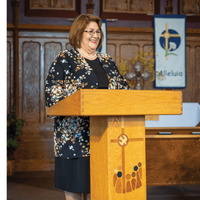
Born the daughter of poor potato farmers in a rural area of Chile, Flor Retamal did not grow up in what could be considered circumstances optimal for success. As an adult she lived through a military coup, raising her two young daughters alone while her husband was held as a political prisoner for several years. When her family was finally able to find refuge in America, a whole new set of challenges presented themselves, including language barriers, finding work, and finding community. But throughout these challenges, God continually showed favor to Flor and her family, eventually making her a pillar of her community as a teacher, and a voice for Hispanic culture and Hispanic women within the Evangelical Covenant Church.
As many of us lead comparatively safe, sheltered lives, it is easy to be in awe of Flor and thankful for her story, but unwilling or unable to see its connection to our own lives. But as we look deeply into our own stories and are honest about the times we’ve been angry about our circumstances, wondering why God would allow them, suddenly we are not so far removed from her and from her story.
In Romans 8:28 Paul writes, “And we know that in all things God works for the good of those who love him, who have been called according to his purpose” (TNIV). The story of Flor Retamal is a story of God’s provision, or his timing and his plan for each of our lives, working all things together for good, for our growth and for his glory.
Elsa and Alberto were only sixteen and seventeen years old when their daughter. Flor was born in the small town of Puerto Varas. Chile. They would carry their little girl into the middle of the potato field where they worked, praying that God would bless her and that one day, she would be a teacher.
“They were dreamers,” remembers Flor. “They wanted the best for me and for my brother and sister as they came. They were very committed to giving us an education, even though they themselves had almost no education whatsoever.”
To accomplish this, Elsa and Alberto moved their family—Flor, Luisa, and Luis Alberto—to Puerto Montt, the next biggest city to Puerto Varas. Leaving the potato fields, Alberto found work selling fruits and vegetables in the neighborhood, progressing from two large baskets carried on his own shoulders, to a horse-drawn cart, to a fruit store, and eventually to his own small grocery store. He would take Flor along with him in a small delivery truck, bringing groceries to various locations in the neighborhood, including the local convent. “I don’t remember this at all,” says Flor with a laugh.
But one day the nuns saw me. They had a school in the convent where kids went during the day. and another small group of orphans stayed with them evenings as well. They told my father they would like to include me and would give him a grant. Since he and my mother spent all day outside, they thought this would be best for me. So, at age six, I started boarding school.
Flor lived and learned with the nuns, returning home only for summer and winter vacations, until she was twelve years old. She doesn’t remember many specific events from those years, but she recalls hours spent praising God and searching for the Lord at a young age. At one point, she even considered becoming a nun herself. Her parents, however, thought it would be more practical to become a teacher than to enter the religious life, so at age twelve she left the convent for public school, a requirement to enter the school for teachers, the escuela normal.
These plans were put on hold when one of the most powerful earthquakes in Chile’s history hit Valdivia on May 22, 1960. This famous quake had a magnitude of 9.5 on the Richter scale, and seismic measurements determined that it caused several smaller earthquakes throughout Chile and Peru, as well as tsunamis all the way to California, Hawaii, and Japan. The earthquake was responsible for the deaths of more than 2.000 people, the injuries to another 3,000, and left 2,000,000 homeless, devastating several small port towns, including Puerto Montt.
“After the earthquake, my school building was practically destroyed. My father sent my sister and me away to the capital [Santiago] to finish school,” remembers Flor. “That was the year I was supposed to take my test to get into the escuela normal. We went from one place to another across the north side of the country, and when I finally returned, we could no longer take the test. I had to wait until the next year. I passed and was sent to the teacher’s school for six more years, away from my city.”
As sad as she was to be in Ancud, an island seventy miles from home, Flor recalls that time as being critical to building the independent nature she is now known for. For six years she made sure that she attended class, did her homework, studied and took care of all the day-to-day responsibilities that her parents had once attended to. And at age eighteen, in addition to becoming an adult she also graduated with her education degree. It was an intense transition to go from daughter to instructor so quickly, but Flor was motivated by her thoughts of home. “That was what pushed me forward, thoughts of my parents,” she says. “I knew that if I wasted a penny, it was a penny that could have been used at home. I had so many people who encouraged me—good teachers, nuns, people who knew my parents—but in every letter I wrote, I was always most thankful to my parents.”
In 1969 Flor was completing her time at the escuela normal. Much of the excitement in her life at the time, however, was not related to graduation, but to more adult concerns such as politics and love.
Having worked hard throughout his life, but continually disappointed with the meager rewards for that work as a means of providing more for his family, Flor’s father was a firm believer that society was unjust. “He believed in the social movements, justice for everyone,” says Flor. “He hadn’t been involved in politics when we were young, but I definitely remember being persuaded to work with the Socialist youth during my time in teaching school.”
Through this work with the Socialist youth. Flor first met Luis Retamal, an active volunteer with the Socialist party. As she remembers it, “He was more of a student leader than a politician, and together we were organizing groups, going around the city and meeting with other young people.” Whether it was the fervor of the time or the headiness of the city, Flor and Luis fell in love almost instantly. “We’d been dating for only four months when we told my parents we wanted to get married." she says with a laugh. “They said no; it was too soon. So we waited three more months and then we got married.”
Luis also came from a poor family living in Puerto Montt. He had chosen to pursue higher education as a means of escaping the cycle of poverty. He was a leader at his small university, Universidad Tecnica, and was rapidly becoming a political presence on campus.
Due in large part to the hard work of students and volunteers like Flor and Luis, Salvador Allende. a leader of Chile’s Socialist party, the group heading the Popular Unity coalition combining Socialist, Communist. Radical, and Social-Democratic Parties, was elected president. Many people were ecstatic over his victory and in particular, the peasants and farmers such as Flor’s father who stood to gain from Allende’s plan for land redistribution. But there were others, powerful others, concerned about how their interests might be infringed upon by Allende’s politics of the people.
Despite early economic success, by 1973 Chile was a country of warring factions. In September of that year, the Chilean military led a coup against Allende, and the army’s commander, Augusto Pinochet, established himself as leader of the nation. And while the national implications of the takeover were grim, the personal ramification for Flor would push her to her very limit. In an effort to take down not only Allende, but his supporters as well, the military coup involved the arrest of people at various levels of the Socialist party, including Luis. Much had changed since the election in 1970, however, and the Retamal family now included one-and-a-half-year-old Patricia (Patty) and another baby less than three months from birth. “My husband was arrested the day after the military coup,” says Flor with a deep sigh, forcing herself to remember the start of an arduous journey.
It was eleven or twelve at night when the military came to our house, broke into our home. It was September 11, 1973. We’d heard the news about the coup and we knew what happened in other countries with military dictatorships, so we knew what to expect. Maybe because I was pregnant, or maybe because we were too naive, but we didn’t hide, we stayed home.
Luis had spent the day at his sister’s house, but of course the soldiers came at night. My house was a little house and suddenly it was full of twenty or more soldiers. I can still feel it, and when I remember I can still hear their boots on the floor and the sounds of triggers as they cocked their guns. They came in and destroyed a whole bunch of our things in their search for possible arms. I still see Patty crying and going around the soldiers.
And just like that, Luis was taken.
The next day, still frightened and unsure of what she should do, Flor received a second group of visitors. Flor’s aunt, who lived in a house around the corner, had seen the search and Luis’s arrest from her window. This particular aunt had been raised Catholic but had converted to Protestantism. That morning she’d called upon friends from her small evangelical church and together a handful of them came to help Flor and pray for her and her family. “They told me that if I trusted the Lord, everything was going to be okay, that no matter what happened, he would help me,” she says. “They told me that I had to put all my trust in the Lord for the life of my husband; I had nothing else to trust in. Later that day, I gave myself to Jesus.”
Although “officially” Luis was listed as a missing person, Flor had a contact in the detention center who was able to provide her with information on Luis’s condition: he was alive. Flor remembers being scared and anxious, unsure of what was going to happen next. “Those were terrible days. I didn’t even know how to pray, but I guess the Spirit gave me the words.”
The women from her aunt’s church began to teach Flor about prayer and the Bible. They usually were limited to a half-hour visit, wrangled somewhere between dinner and the government-imposed curfew which prevented them from traveling the streets at night. “We were reading Scriptures and I remember how Jeremiah 33 just leapt out at me,” she recalls. “From then on, everything was a Scripture for me; I just became so attached to the promises of God. Even today, I have promises from the Bible for anything and anybody. I learned to make the promises my own.”
Following his initial arrest, Luis was held for only eight to ten days. While there, he started praying for the first time since his childhood. His mother had been a devoted evangelical Christian, but as an adult, Luis had never really taken faith seriously, and that definitely didn’t change during this stint in jail. “When he got out, I thought my prayers were answered,” says Flor. “He was not converted or committed to Christianity, but he was home.”
Despite Luis’s homecoming, tragedy still seemed to surround their small family: friends were killed, houses were torn apart in futile searches for weapons, Flor’s brother ran away to Argentina, and the military had a detail following Flor’s father. “There was so much chaos and destruction. My family was destroyed and everyone was scared. It seemed as though I had no friends because everyone was focused on protecting their own life.” It got to the point where Flor’s friends would ignore her if they passed on the street. Many were afraid that the new regime would come after their own family just for knowing the Retamals. “I was the most lonely person in those days,” says Flor.
During this time Flor started going to church regularly but before she had time to settle in, Luis was taken again, and this time her prayers were not so quickly answered.
In describing the second visit from government soldiers, the best word Flor can muster to describe it is “rude.”
“It was a terrible experience, which wasn’t anything new. but this time it wasn’t soft,” says Flor, closing her eyes and taking herself back to that evening. “They came, they tied his hands and they pushed him on top of a military jeep. Patty witnessed everything. I remember looking out the window, crying, watching my husband get thrown in the back of this truck with his friends.”
In the beginning Flor thought it would be like the first time—difficult but over in ten days or less. But when those first ten days passed, and then a month, and then two months, she came to the harsh realization that things weren’t going [118] to be so easy this time. She continued to teach and in between classes she would go to different people she knew in town, asking after any information regarding Luis. And in the midst of these “crazy days,” she was faced with a new burden as her school found it difficult to pay teachers regularly, sometimes cutting off her income for weeks at a time. Other teachers helped to collect money to help her pay rent and feed Patty—but their generosity was stretched to its limit as Flor prepared for the birth of her second child.
Flor went into labor on November 3, 1973. After a day of contractions, she sensed that as evening fell on the fifth, the time was getting close. “We were on curfew,” she remembers, “and I knew the baby was going to come before we could go out again in the morning. At 6:30 a.m. on the 6th, my mother, who was with me, left the house, knowing that if she were seen, she could be shot.”
Seeing no military jeeps in the area, Flor’s mother was able to sneak over to the nearest police station located seven blocks away. There the police sent a jeep to go get Flor—there was no ambulance. “Anita was almost born between four military men,” says Flor. “I remember being in so much pain in the jeep, holding it in so she wouldn’t be born there. It was an open jeep and just so sad. That’s the only thing I remember.”
When they arrived at the hospital ten minutes later, Anita was born almost as soon as they stepped through the door. As soon as she held her new daughter in her arms, Flor began to worry. “In those times, working people had insurance, but in our case, everything had been stopped.” she says. “When Patty was born, we had everything for her. When Anita was born, we had nothing. I felt so bad, so guilty. I wasn’t able to provide anything for her.” Flor’s sadness was intensified by her disappointment and worry over the fact that Luis was not able to be present for the birth.
Flor had managed to scrounge up bits and pieces of information regarding Luis’s arrest. “Every day they would take him to the interrogation building,” she begins,
and when they told me that he was going to go, I was brave and I waited outside the place he was taken and looked at him coming in and going out. I just wanted to be sure he was alive. I would sit in the center of the city in the area called la plaza. I would sit on that street for hours, waiting on the corner for some sign of military movement and even though they would bring in the prisoners lying down I would know Luis when I saw him because I recognized his shoes and the bottom of his pants.
In the end, the government sentenced Luis to 194 days of solitary confinement. After that, he was moved to the #18 cell on the second floor where he lived out the rest of his almost three years in captivity. Even before he was released from solitary, however, the “international movement” had come to Chile in the form of organizations such as Amnesty International, the World Council of Churches, and the American Red Cross. Flor counts their actions as the primary reason Luis was able to escape the death penalty. “The military had sent a ‘death caravan’ through the provinces starting on the north side of the country, killing all the opposition leaders in each town,” says Flor. “When they came to our province my husband was one of the eleven who was supposed to die. The province just before ours was the last one to suffer before the international organizations put a stop to the killing. I can see the Lord’s hand there; I can see the miracle.”
During this time, Flor’s church came alongside her physically, emotionally, and spiritually, helping in any way they could, providing food, prayer, and support. “My pastor and his wife took me in as though I was one of their daughters,” she recalls. “They loved me and helped provide for me even though they had very little themselves.” The congregation comprised no more than thirty people but that small enclave quickly became Flor’s surrogate family, laying a foundation for her future views on how church community should look and feel. “That little church was the reason I survived,” she says. “I lived close to the church and attended all the services, helped care for the kids in Sunday school and in the youth group and anything I did, the Lord showed that he was with me.”
Meanwhile, in the #18 cell, Luis had his own spiritual awakening. The Gideons provided him with a New Testament in his cell, which he read cover to cover more times than he could count. Unable to go to church, he would instead kneel in his cell and pray. By the time he left prison, Luis had rediscovered the God of his childhood.
God was now showing himself faithful, delivering not one miracle, but two. The Retamal family had a chance to leave the country, a dream for political prisoners. While hurried trials condemned Luis to first forty, then eighty more years in prison, Flor traveled 700 miles to Santiago to look into their opportunity to escape.
An international bank had frozen its account with Chile at the time of the coup and was now using this hold on their money as a bargaining chip in the release of prisoners. Flor applied to five different countries, the United States was her last choice. Even though she was able to speak and write some English well, she was put off by the country’s involvement with the coup in Chile. At the time, she was one of 5,000 applicants for only 400 available U.S. visas, so Flor just filled out the application and let it go. Fortunately, God’s hand was at work.
In Boston, a young man who had completed his practicum at the same university Luis had attended in Chile began to hear stories about the arrests and murders in the country. He began asking questions about Puerto Montt, the town where the Retamals were, and when he learned about Luis’s imprisonment, he went to the State Department and asked for his release. Meanwhile, half the continent away, a youth group at a Solel Synagogue in Highland Park, Illinois, was learning about political prisoners in Chile; a guest speaker had come to [220] share with them the possibility of sponsoring a family. The church contacted the State Department for a list of families in need and out of the 4,000 names they chose the Retamal family, two adults, two children. In Chile, Flor received a postcard: “Flor, you have to learn English. You’re coming to the United States.”
They started without much hope, just a feeling. She had to leave everything in Chile—her mother, her father, her little house, everything she knew. It was so painful and she remembers crying and crying on the plane. Some people in the church had told her before she left that the Lord could bless her husband in Chile, but she always said, “I’ll go wherever the Lord wants me.” It was a promise and now she had to live up to her part of the promise.
Three months after arriving in Chicago, Flor found Edgewater Covenant Church and in doing so discovered a gift for helping young churches to flourish. Toward the end of 1983 the entire Retamal family started to attend a Covenant church plant in Schaumburg, Iglesia del Pacto de Schaumburg (known today as Renacer), while continuing to live in the city. They were there three days a week: prayer meeting on Wednesdays: youth or women on Fridays or Saturdays; and Sundays for Sunday school and worship.
In this new church in Schaumburg, Flor first became acquainted with Covenant Women. Already active in the Mexican community in Chicago, Flor was eager to bring that same sense of camaraderie to her Hispanic sisters in Schaumburg. “One day we just formed the first Hispanic CW group. The first group had maybe twelve. We didn’t know we were the first; we just thought it was something we needed to do,” says this trailblazer.
The Schaumburg group attended Triennial VI in Fort Collins, Colorado, in 1989. “We were excited to learn and be part of a larger organization.” Flor caught the vision of Nancy Reed, a missionary to Mexico, to unite Hispanic churches across Chicagoland and all across the continent, helping connect Hispanic women everywhere. At the first official meeting of the Chicagoland district, Flor was elected district president.
With the simple gifts of ability to teach and to relate experiences to her own life, Flor helped launch a segment of Covenant Women that now impacts thousands of Latina women, providing them with a common identity and a confident voice.
When the group first started, their initial purpose was to have fellowship and more importantly to recognize that they’re not just a small group in a church, but that other churches have the same small groups and together we can do big things for the kingdom. When Flor became president, she was “looking over all the churches, making sure that everyone was working and providing encouragement.” She takes that same initiative into each leadership role she assumes. Flor was the first Hispanic woman on a Triennial committee and first to help coordinate its translation efforts at each meeting. She was the first Hispanic on the Women Ministries’ denominational board, and the first woman on the denominational board for Hispanics. She is co-founder of the Regional Hispanic Women Ministry and a frequent presenter on women’s leadership at various conferences in the United States and Latin America.
Today nearly thirty years later, these efforts by Flor and the many women who stood with her have helped shape the Evangelical Covenant Church to bring much-needed diversity. “In the beginning there was such a language barrier,” she says, “that there was almost no communication and we were an entity that nobody cared about. There were a few Hispanic pastors who went to annual meetings —and no one could understand them. But I feel the Covenant is seeing us now, they desire to listen to us and that’s the biggest accomplishment.”
Not that Flor is anywhere close to retirement, but in reflecting on her legacy she wishes to be remembered not only for her work in the Covenant, but in her general community and in schools as an activist and a teacher, equipping families with basic necessities like blankets and heaters, and equipping her students with the knowledge that will help them live meaningful adult lives.
For all who know her, she models an attitude of grace and strength. She shines as a beacon of possibility, not only for Hispanics, but to anyone who struggles under oppressive circumstances. Living within a culture often stereotyped as strictly Catholic and stubbornly patriarchal, she has defied both generalizations to become a strong evangelical leader in her church, home, and city. Within a historically Swedish denomination, she has introduced a new recognition and appreciation for the Hispanic culture and its gifts. She will be remembered as a woman who challenged herself and others to fully live into God’s promises.