
Diane Ruebel
- Name
- Diane E. Ruebel
- Year of Ordination
- 1996
- Item sets
- Women's Ordination - People
- Media
 Ruebel pic cropped.PNG
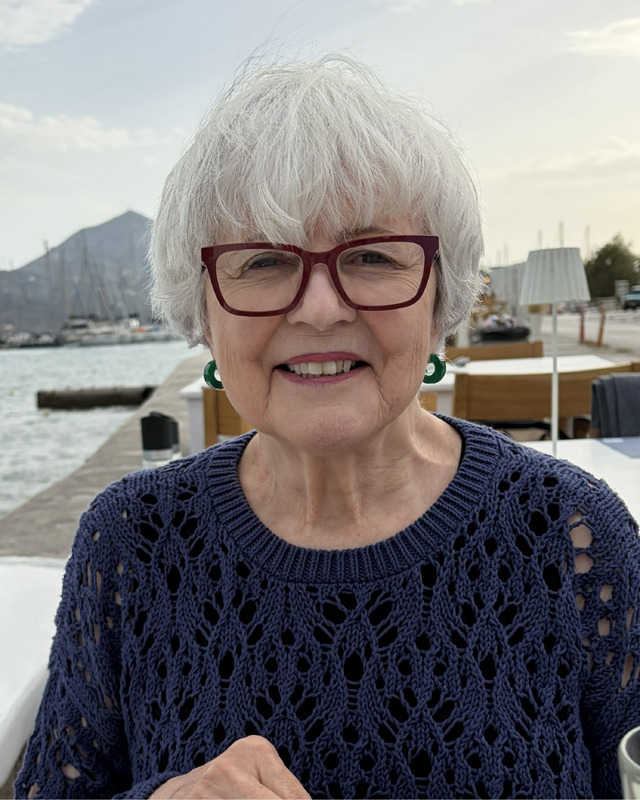
Rev. Diane Ruebel was the first woman to serve as a pastor at Seattle First Covenant Church in Washington State. Diane was born in Seattle, Washington, in October 1943. Throughout her childhood, Diane’s family attended Rainier Beach United Methodist Church, where she developed a strong sense of community values and had her first spiritual experiences. She regularly attended Sunday school and soaked up the Bible stories she learned there. Even during the summer months, she and her friends would play “church” once a week, and Diane would always play the role of preacher. In the summers Diane would also attend her church’s camp. It was at camp after her junior year of high school that she had her first mystical experience. She told her pastor, Rev. Paul Andrews, about the experience, and he validated it, helping her to feel affirmed in her spiritual gifting.
After attending college at the University of Washington, Diane became a teacher. In 1964, she married Dr. Tom Ruebel, and they started a family together. Early in their marriage, they attended a Bible study fellowship in Bellevue, Washington. There she met many women whose kindness impressed her. She learned that these women all attended the Evangelical Covenant Church. This was her first exposure to the Covenant. When she and Tom moved to Salem, Oregon, in 1976, she noticed a local Covenant church and decided to visit with her family. In contrast to other churches they visited, this one had robust offerings for children. Her children appreciated the content geared toward them, and Diane appreciate the Pietist ethos. After one visit, Trinity Covenant Church became their new church home.
During their time at Trinity Covenant, Diane became involved in small group ministry. Her experience piqued her interest in spiritual formation, an interest that would guide her the rest of her life. She taught classes at the church and later served as a deacon. In 1980, the church called Rev. David Smith as their new pastor. He had a vision to call gifted people on staff in half-time roles. One of these gifted people was Diane. She was called as a visitation and spiritual formation leader. Rev. Smith started to ask Diane to do things on Sunday morning, too, like serve communion. People in the congregation began asking if she had considered pastoral ministry, to which she adamantly replied, “no.” While the vote to ordain women in the Covenant had passed a few years before, Diane knew it was still a contentious issue and was not eager to get involved in those struggles.
However, Rev. Smith asked Diane to take a year and enter into a discernment process. She relented and invited people she trusted to pray on her behalf. During that time, Diane visited the Ignatian Spirituality Center in Portland and began a spiritual direction relationship with Sister Carla Montante. Sister Montante taught Diane how to slow down and listen for God’s voice, and how to have compassion for herself. Tom and Diane both took a class on spiritual discernment and the Johnson O’Connor aptitude test. The test informed Diane that the dynamic nature of pastoral ministry would be a good fit for her. As Diane’s discernment process continued, the dean of North Park Theological Seminary, Rob Johnston, flew out to Oregon to meet with her. He told her that if she got her degree from North Park, they would know her well and would help make ministry possible for her.
Diane’s discernment process led to her entering seminary in 1988. Diane’s husband and sons were very supportive of her call to seminary, encouraging her along the way. Over the course of her education, Diane took classes at five different theological institutions but received her degree from North Park. She completed her Clinical Pastoral Education in Seattle when the family moved back from Oregon. Throughout her seminary experience and ordination, Diane found the Covenant to be both nurturing and supportive.
In 1994, Diane received her ordination in Anaheim, California, along with five other women. Her husband and sons were there to cheer her on. Diane and the other women ordained into the ECC together became great friends, taking regular retreats as a cohort. Diane was part of the second wave of women who sought ordination and call in the Covenant. The first wave had to fight their way in, and Diane remembers them being unfairly labelled as “angry women.” While their anger was justified, it also meant that they were perceived in a negative way by many in the denomination. Diane and the second wave of ordinands were mostly women for whom ministry was a second career. She noted that by the time they found their way to ministry, most of them had learned in their own lives that anger did not motivate them. As such, they found they had an easier time finding calls to churches, and so there was some tension between the second and first waves of ordained women. During this challenging time, Diane found support especially from the mentorship of Rev. Eva Sullivan-Knoff and Rev. Jolene Bergstrom Carlson.
Diane’s first call was to First Covenant Church in Seattle, Washington. She was the first woman to be called there, and she served as associate pastor from 1992 until 2001. When First Covenant’s board recommended Diane for candidating, she insisted on having a thorough process that would help the church get to know her and become more comfortable with the idea of a woman in pastoral ministry. With the help of Rev. James Anderson and the church chair, Dick Sundholm, Diane developed a process that provided many points of connection between her and all church members. She met with each of their small groups, offered to have one-on-one conversations with anyone interested, held a general question and answer time for the whole church, and gave a presentation on the scriptural rationale for women in ministry. For this, she relied heavily on the work of North Park professor Dr. Klyne Snodgrass.
Despite all of this, there was still a contingent of the congregation that was displeased with her call. Some left the church. Even among those who stayed, some remained unsupportive. They would call on a Sunday morning to ask who was preaching; if it was Diane, they would not attend. Overall, Diane felt supported by the congregation and especially by the leadership. Rev. Anderson even asked if she wanted to be co-pastors at one point, though she declined. In 2001, Diane resigned during a difficult season for the church.
After her time at First Covenant, she and Tom moved north to Camano Island, Washington, bought a piece of property, and built a home with a retreat center for pastors and their spouses. They named it Eaglewood. Tom and Diane built a prayer labyrinth on the property and provided spiritual direction to their visitors. Diane transitioned from church ministry to spiritual direction as her primary focus. She attended the C. John Weborg Center for Spiritual Direction at North Park, graduating with the center’s first cohort. Diane found special joy in spiritual direction. She says spiritual direction is like “being a midwife for the soul.” She even moved on to train other spiritual directors. Rev. Don Robinson encouraged her to become Supervisor of Practicum for Spiritual Directors for the ECC. Diane also served on the Board of Ordered Ministry for five years and as a trustee of North Park for another five. She served as a spiritual director up until she and Tom moved into retirement housing at Covenant Living at the Shores on Mercer Island, Washington.
Overall, Diane has had a positive experience serving in the Covenant. She especially credits the courageous leadership of Rev. Dr. Glenn Palmberg who created more opportunities for women pastors and leaders during his years as president of the denomination. She does believe that the church growth movement that swept the ECC negatively impacted women’s ability to find call in the denomination. The focus on finding pastors who were entrepreneurial excluded many women from receiving call and promoted the inclusion of men from more conservative seminaries. She believes this led directly to the ECC’s statement on human sexuality and its current position, which she describes as “judgmental.” She believes the Pietist ethos of the Covenant was damaged by these decisions and has caused harm to pastors who sought to preserve the Covenant’s Pietist heritage. Diane laments that many of her friends and mentors are no longer part of the denomination for these reasons.
Even in retirement, Diane continues to find ways to use her gifts. She leads contemplative lament walks around the Shores every other Saturday and facilitates group spiritual direction for a small community of women who call themselves the Sad Sisters. Diane remains a member of the dispersed contemplative community, Selah, and a regular attender at Seattle First Covenant Church.